
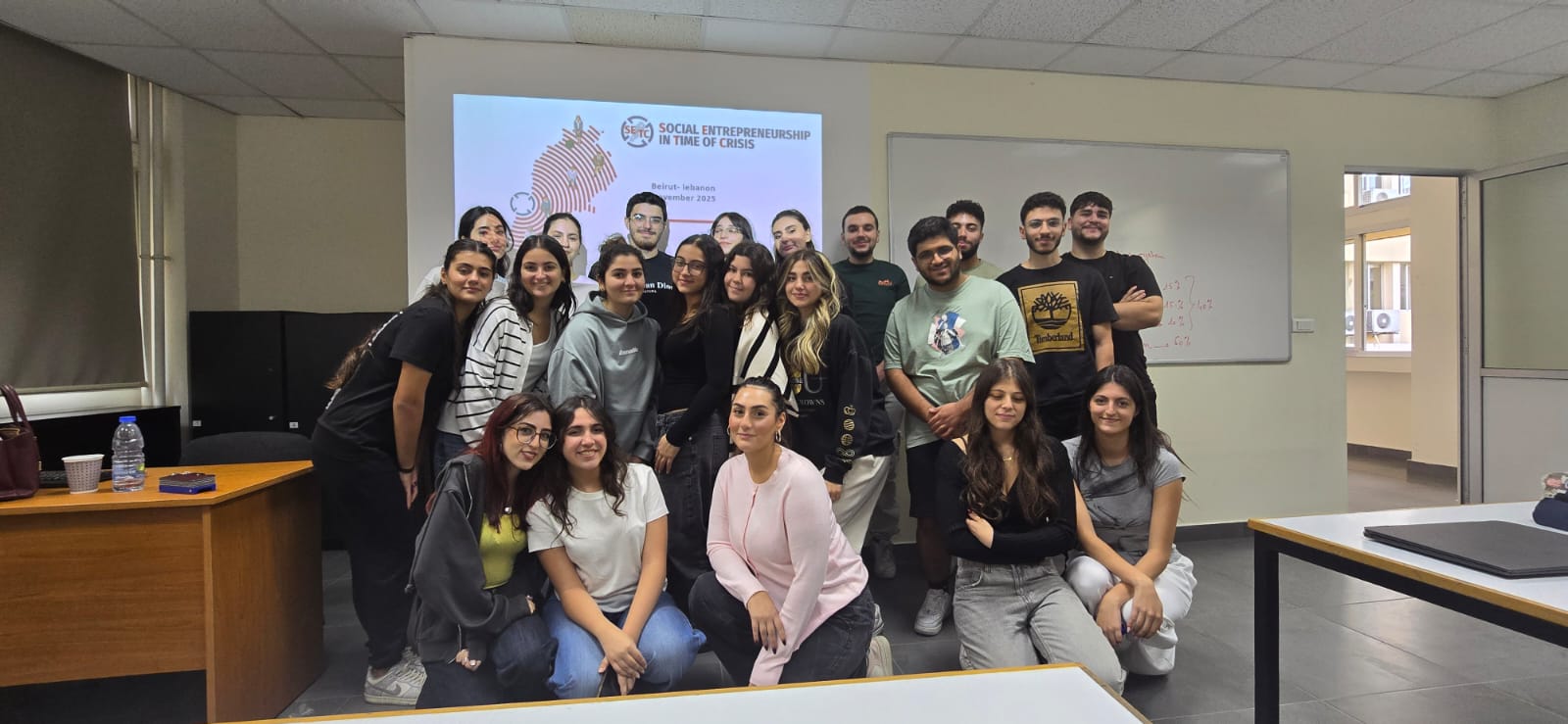
Undergraduate students at the Business School of Saint Joseph University of Beirut (USJ) took part in an intensive awareness campaign on social entrepreneurship titled “The Triple Bottom Line Revolution: Profit, People, Planet” last November 2025, organised in the framework of the SE.TC – Social Entrepreneurship in Time of Crises project.Led by Dr. Rima Rouhana, the campaign unfolded over three in-class sessions and challenged students to rethink the traditional business paradigm, moving from profit-only models towards purpose-driven enterprises that combine financial viability with measurable social and environmental impact.
Rethinking business in times of crisis
The first session, “Rationale for Integration: Building Resilience”, introduced students to the realities of operating in contexts marked by financial, political and humanitarian crises.
Dr. Rouhana presented social entrepreneurship as a framework to close institutional gaps, not by treating them as failures, but as market opportunities for innovation. Drawing inspiration from the SE.TC project, the session focused on how to design business models that are resilient, inclusive and mission-driven—a skill that is increasingly non-negotiable for modern business leaders.
Students explored how social enterprises can respond where traditional institutions fall short, particularly in crisis-affected environments like Lebanon, by anchoring sustainability and social impact at the core of their strategies.
In the second session, titled “The ‘Crisis as Opportunity’ Challenge”, students worked in teams to identify and analyse current local challenges, such as:
- Waste management and infrastructure failure
- Limited access to essential medicines and healthcare
- Barriers faced by vulnerable groups in accessing education or employment
Each team was tasked with developing a social enterprise concept that addressed one of these issues. They were asked to clearly articulate:
- The social value proposition (the concrete social or environmental problem being addressed)
- The financial revenue model that would ensure the solution’s sustainability
The exercise pushed students to move beyond temporary aid, designing solutions that operate as viable enterprises capable of lasting impact and scalability, even in volatile environments.
Expert spotlight: recorded pitches
The third session took the format of an Expert Spotlight Series, where students recorded 7–8 minute pitches. In their videos, they imagined inviting local social entrepreneurs or impact investors to share their journeys, with a focus on:
- Balancing social mission with financial sustainability
- Managing trade-offs and hard decisions under extreme uncertainty
- Demonstrating how purpose-driven ventures can remain viable in crisis contexts
This recorded component helped students practice storytelling, pitching and impact communication, crucial skills for entrepreneurs and future managers operating in the social impact space.
Among the case study videos developed by the students, the campaign chose to highlight “The UWYTA Project (Empowering Women in Crisis)”.
The UWYTA Project focuses on strengthening women-led startups in Lebanon, directly addressing the ongoing socio-economic crisis. Through the lens of the circular economy, the initiative promotes sustainable, local and handmade production.
The campaign features a short video showcasing the project’s social entrepreneur, beneficiaries and their sustainable businesses. You can watch the video here.