
Analysis of the state of the art
Lebanon preliminary data. Report for public [download]
An assessment was developed about the specific needs of the project beneficiaries (students and trainers) in the four Lebanese universities: Saint Joseph University, Lebanese University, Université La Sagesse and Al-Azm University/now East International University. This report aims to show students’ perceptions of social entrepreneurship, examining how well they perceive it and how Lebanese universities are doing in teaching SE. In addition to exploring students’ perceptions, the report also investigates their motivations and barriers towards engaging in social entrepreneurship. A second investigation was conducted among +50 instructors in higher education, aiming to understand their perspectives, challenges, and recommendations regarding entrepreneurship education. The overall scope was is to build strategies that align with the needs and aspirations of the academic community, cultivating a supportive environment for entrepreneurship development and shedding light on potential areas for curriculum development and specialization.
Train the Trainers
The implementation of local training workshops is grounded in a Train-the-Trainers (ToT) model, which represents a cornerstone of the SE.TC project’s strategy for scalability, sustainability, and systemic impact. Rather than delivering training directly to a limited number of end beneficiaries, the project adopted a cascade approach, whereby academic staff from partner HEIs were first trained at an international level (with meetings in Limerick – Ireland in April 2024, Rome – Italy in November 2024) and subsequently empowered to replicate the programme within their own institutional and national contexts. This model enables a multiplication effect, ensuring that knowledge and competencies are not confined to the initial training phase but are continuously disseminated over time.
Importantly, the ToT phase did not focus solely on the transfer of content. It was designed as a “comprehensive capacity-building process”, equipping trainers with: advanced knowledge of social entrepreneurship concepts and tools; pedagogical methodologies tailored to experiential and practice-based learning; evaluation techniques to assess student performance and learning outcomes; the ability to adapt training content to local socio-economic conditions.
As evidenced by partner implementations, this approach led to the creation of “institutional trainer networks”, capable of independently delivering training, mentoring participants, and contributing to the long-term integration of the SETC curriculum within academic structures.
Train the students
Building on the Train-the-Trainers (ToT) approach, academic staff previously trained at international level successfully transferred knowledge, methodologies, and pedagogical tools to a broader audience at local and national level. This ensured that the project moved beyond pilot training into a sustainable, scalable capacity-building model.
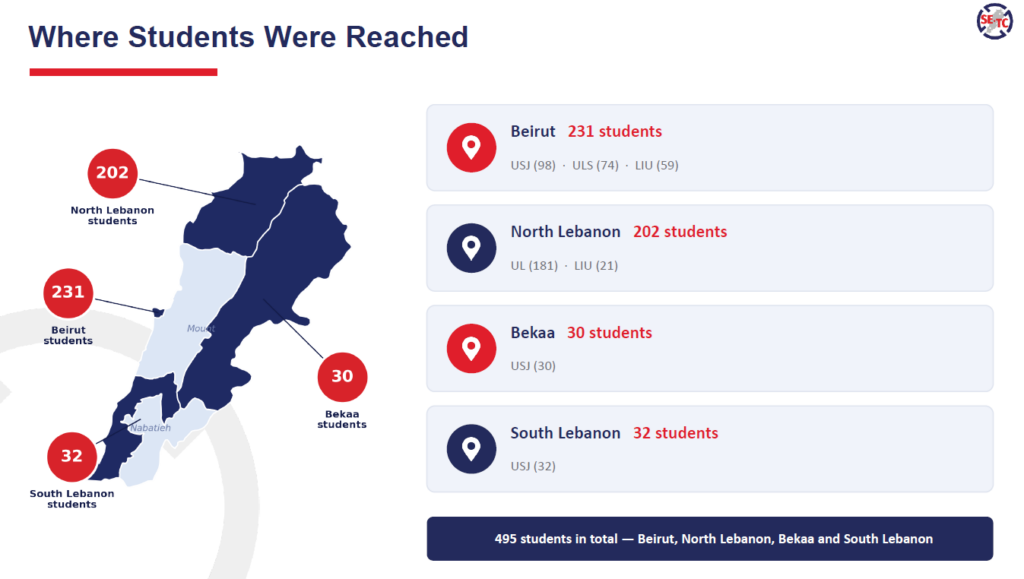
Training workshops have been held in all the 4 Lebanese Universities of the Consortium across the second half of the project, in the form of a series of in-presence sessions targeting Lebanese students and youth. These workshops are meant to encourage a broader engagement in social entrepreneurship: throughout the different occasions, participants expressed strong desire to deepen their knowledge, particularly in areas of financial literacy and sustainability, legal structures, strategic partnerships and crisis resilience, as well as marketing, management and operational models of social enterprises. Overall the workshops involved almost 500 participants among students and educators.
Universities play a crucial role in nurturing future social entrepreneurs, and through the training workshops SE.TC is integrating social entrepreneurship into higher education, providing students with the possibility to develop their innovative ideas starting from a solid knowledge base. Crises often breed innovation, and Lebanon’s youth have the potential to rise to the challenge. By fostering an entrepreneurial mindset and providing the right tools, SE.TC is ensuring that Lebanese students are not just preparing for the future but actively shaping it.
- Saint-Joseph University [June-July 2025]
- Université La Sagesse [June-July 2025] [November-December 2025] [May 2026]
- Lebanese University [June-July 2025] [February 2026]
- East International University / Lebanese International University [June 2025] [December 2025-January 2026] [January 2026]
Raise Awareness
- “Innovate for Social Impact”: finding ways and solutions to foster social entrepreneurship in Lebanon, June 2024 [link]
- The SE.TC project lands at Erasmus Days. Watch the video and discover the story of Firas Yehya, a young Lebanese entrepreneur, October 2024 [link]
- Transforming challenges into social innovation in Lebanon. How SE.TC is empowering Lebanese youth, April 2025 [link]
- Erasmus+ Webinar “Universities as Catalysts for Sustainable Development: Reimagining Higher Education through SDG4” | 23-24 September 2025, September 2025 [link]
- SE.TC Days, October 28-30, 2025 | Beirut hosts three-days event in the framework of SE.TC project to boost social entrepreneurship and digital education in Lebanon, October 2025 [link]
- The triple bottom line revolution: “Profit, People, Planet” – SE.TC Awareness Campaign at USJ Business School, November 2025 [link]
- SE.TC featured in the Erasmus+ Lebanon Newsletter [link]
- SE.TC Stakeholders Forum Promotes Social Innovation in North Lebanon, July 15, 2026 [link]
Curriculum Development and the delivery of a MOOC on Social Entrepreneurship
Ownership and sustainability
- The Third Level Impact [link]